
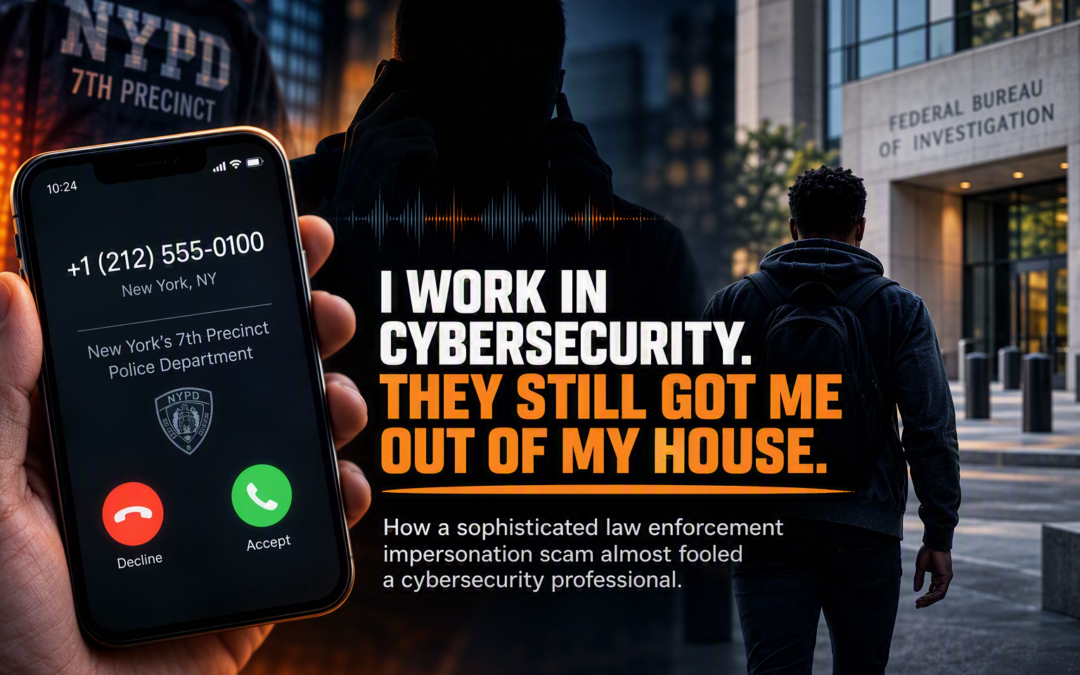
A warning and testimonial written by our very own Kameron Holness.
I work in cybersecurity & they still got me out of my house. I didn’t provide any information or make any payments, but they got me out of my house, and that is terrifying. Here’s how it happened.
I was at home doing some work on my computer. I get a call from New York, immediately questioning it because I don’t live there but it is close enough to be someone or a business I have dealings with. It wasn’t labeled as spam risk, so I answered.
“Hello, this is the New York’s 7th precinct police depart—”
Click. I hang up. There is no reason for them to be calling me. If it’s really serious, they’ll call back.
They do.
I answer.
“Did you just hang up on me? This is an important call. Are you Kameron Holness?”
We bicker over why I hung up on them, and I ask them to get to the point of the call.
They confirm my name, the city where I live, and begin telling me that someone impersonated me and opened an account for a phone line in Canada and had successfully defrauded several people. Imagine my confusion. I know my information has been leaked (almost everybody’s has), and people have tried to impersonate me for fraud purposes in the past, but Canada? That seems crazy. Why aren’t the Canadian authorities contacting me then? Who are you?
I ask for the officer’s name and badge number and look them up on NYPD Online (an online database with searchable data on the NYPD). They exist and correlate. Then I confirm the police station. A quick Google search kept me on the phone: the phone number on the caller ID matched the precinct’s published number. My defenses aren’t down, but now I’m curious. Okay, I was impersonated…now what? What do you want?
I anticipated they would want me to either pay some made-up fee or get me to visit some malicious website. I kept waiting for the ask, but it never happened. (or I didn’t follow the script well enough for the attacker to make it there).
She kept telling me that I needed to file a counterclaim with the FBI or I was going to be brought in on criminal charges by local police. For as serious as that sounds I ask for a case number or something that can verify these statements. She gives me one.
From here, I planned on verifying on my own by calling the NY FBI Field Office myself. They will surely be able to tell me if this is legit or not. Then the other shoe begins to drop.
She tells me I have 2 hours to submit the claim, or the local police will be coming to bring me in. There it is. The urgency factor most scammers play on. But how are you calling me from the verified police department’s phone number?
At this point I’m about 80% sure this is a scam. I continue playing the attacker’s game and ask her what she is proposing I do. She tells me she can help me bypass the “red tape” I’ll go through by transferring me to the FBI directly. I tell her sure.
She connects me, and this guy who seems to have no idea why I’ve called him asks me to explain the situation about 3 or 4 times. He tells me it sounds like a scam, but he will check all the info I’ve given him and call me back. This interaction surprised me and lowered my defenses because I was expecting the scam to immediately pick up where we left off. Still committed to my due diligence, I ask for his identification, and he says he can’t give it to me because “I called him” and he didn’t initially make contact with me. (Google did confirm that federal agents aren’t legally required to identify themselves.)
He said to hang tight and that he would call back.
He does.
The first thing I do is verify the number he’s calling me from. Surely, they can’t spoof the FBI’s number. They can. And they did.
Now I’m 50/50 on whether this is legitimate. I probe again for the ask.
He identifies himself and tells me that I should contact my local FBI field office and file the claim because I’m not a NY resident and “time is running out”.
This sense of urgency really bothered me because I have never heard of any legal proceedings being done this way. If I needed to answer for a crime, wouldn’t law enforcement come to my house straight away or call and ask me to come down to the station? (I live for true crime TV). As the call (and scam) progress, he actually gives me the address to my local field office and says I can either go there, or he can “transfer me” via phone to get it done within the now 1.5 hour window.
I’m sure at this point the local FBI’s number would have been spoofed as well, and that is where they would have finally made the ask for money or access or whatever they wanted, but I had already had enough. I told them I’d take my chances and go to the local FBI myself.
So that’s what I did. I drove to the field office, checked myself in, and explained the whole thing to a real Special Agent, who was surprised at the lengths these people had gone to. He confirmed that this was all made up and there was no claim or case against me at all.
These scammers did their research. They knew things about me and even adopted new tactics to make me second-guess myself. And that’s the part that stuck with me the most. Not the fake badge number, the spoofed FBI line, or even the countdown. It’s that I do this for a living. I know what pretexting looks like. I know spoofing is trivial. I know the “urgency” play by heart because I’ve probably written 15 articles and emails about it by now. And they still were able to play on my emotions.
I’m not beating myself up too much about it. These scams aren’t built to fool careless people. They’re carefully crafted to fool busy, distracted, reasonably informed people who have a hundred other things going on and just want the problem to be over. If it can chip away at someone whose job is literally to spot this stuff, it will absolutely work on your parents, your coworker, or you on a bad day.
So, here’s the actual takeaway: 1. Hang up, and call the organization back yourself using a number you find independently… not one they give you, not one on your caller ID, not one they “transfer” you to. 2. No legitimate agency will threaten you with a countdown clock. And 3, if something feels like it’s building toward an ask, trust that instinct and get off the phone. You don’t need a cybersecurity background to catch this. You just need to know what to look for. Awareness, not expertise, is what actually stops these scams from working.