
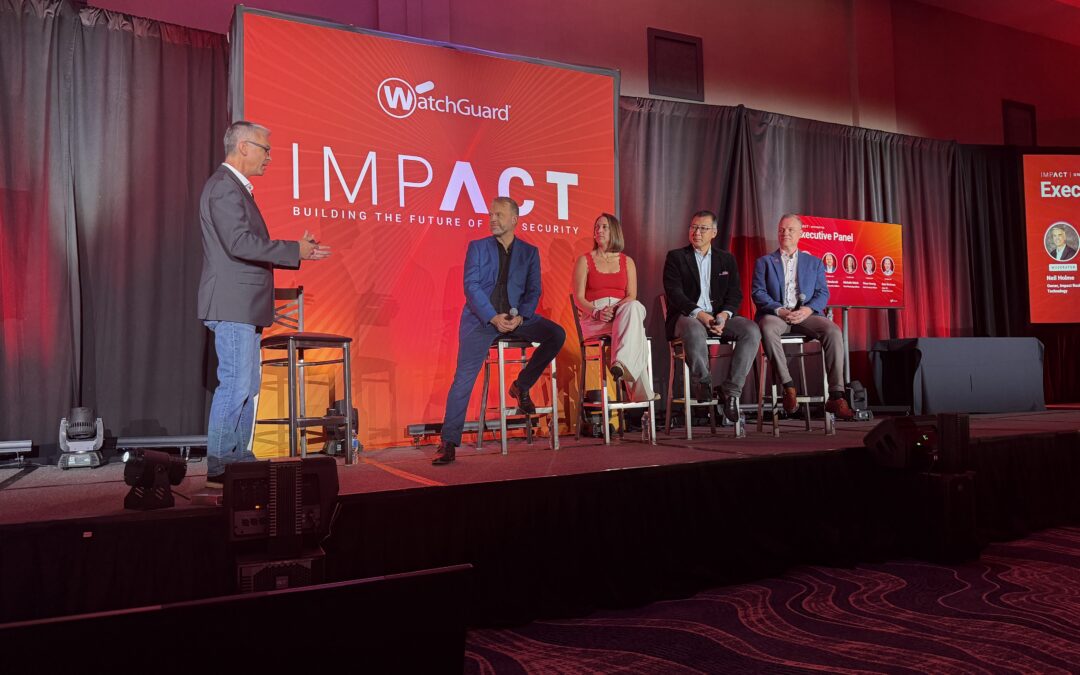
Our founder and CEO hosted the IMPACT Unscripted executive panel in Nashville, putting WatchGuard’s leadership on the spot about AI, vendor sprawl, and what it takes to be a good partner.
When WatchGuard brought its partner community to Nashville for IMPACT North America 2026, our founder and CEO, Neil Holme, had a front-row seat. He also had the microphone.
Neil hosted IMPACT Unscripted, an executive panel with WatchGuard’s senior leadership, including CEO Joe Smolarski, CMO and SVP of Business Strategy Michelle Welch, Chief Product Officer Vince Hwang, and Vice President of Global Renewals Sales Rich Workman. The format was simple: real questions from a working partner, answered on the spot.
It was a fitting seat for the founder of a company that happens to share its name with the conference. We say that with a smile, but the point is serious. WatchGuard asked an MSP that has relied on its technology for years to represent the partner community in front of its own executives, and Neil took that responsibility seriously.
Why this panel mattered
IMPACT is WatchGuard’s flagship partner conference for MSPs, with three days of strategy sessions, hands-on training, and peer insight. This year’s event also carried major news: new Firebox hardware, expanded agentic AI capabilities in the Unified Security Platform, new tools for uncovering Shadow AI, and a clear message that the firewall is evolving into an intelligence layer for the whole platform.
In that setting, Neil used the panel to press on the issues that shape how we protect our clients every day:
-
-
- Too many vendors, too much overlap. Inboxes and exhibit halls are crowded with new security companies. How does a vendor help its partners cut through the noise and avoid bloated tech stacks?
- AI beyond the marketing. Every pitch mentions AI. What is a meaningful application, how do you filter out the hype, and how is the AI that MSPs themselves use being secured? Neil also polled the room on a pointed question: who has an AI acceptable use policy, and who can actually detect violations?
- Where partners should focus next. How has the partner mindset changed over the last 12 months, and what should Pioneer, Performer, and Practitioner partners each prioritize for 2027?
- Regulation and cyber insurance. Both are driving new demand. How should partners turn that into real opportunity for their clients?
- Product or service. Some partners resell licenses while others wrap WatchGuard inside managed services. What does each model need to succeed?
- Keeping a big vendor human. As vendors grow, the relationships get more distant. How does WatchGuard stay easy to work with?
- Cutting through the acronyms. EDR, XDR, MDR, ITDR, SSO, PAM, and more. How do partners and customers know which ones matter?
-
Neil closed by turning the tables with a question for Joe Smolarski: what one thing does WatchGuard need from its partners?
What this means for our customers
The questions Neil asked are the same ones we work through with our clients. Which tools are earning their place in your stack? Where does AI actually reduce risk, and where is it a new source of it? How do regulatory and insurance requirements change what you should be doing this year?
Our seat at the table matters because it helps us answer those questions with a clear view of where WatchGuard is headed. We pair that with the day-to-day experience of running these tools for real businesses, so our advice is practical rather than promotional.
We are grateful to WatchGuard’s leadership team for the invitation, and for answering candidly. We are also thankful to the MSPs in the room who shared their own perspectives during the session.